
Project-Based Learning and Illusion of Learning

TLDR:
Project Based Learning (PBL) might satisfy the emotional and social aspects of being in a classroom but bypasses the cognitive conditions required for meaningful learning. We are trading long-term mastery for short-term excitement.
(If you are already offended reading this, no need to read further. It’s okay.)
I have written earlier how schools mess up learning:
Approach like PBL often demands students to manage multiple cognitive tasks simultaneously (understanding, researching, organizing, collaborating, designing) before they have mastered the foundational knowledge in different subjects/domains.
And, how “flipping” isn’t going to work:
Novice students need structured learning first. Expecting them to learn through projects or discovery alone is ineffective & inefficient because the students have not built the foundational knowledge & skills yet to succeed.
PBL blurs the line between learning and performing, assuming that students will acquire knowledge by engaging in an advanced task. That they are learning as well as doing.
After reading In Praise of Artificial Learning: Lessons from Herbert Simon on Effective Instructional Design by Carl Hendrick, I want to add a few more insights, thoughts, and call to action.
1. The “Activity” vs. “Learning” Confusion
Herbert Simon’s Ant on the Beach parable reminds us that just because a path is complex doesn’t mean the ant is thinking deeply; it’s just reacting to the environment.
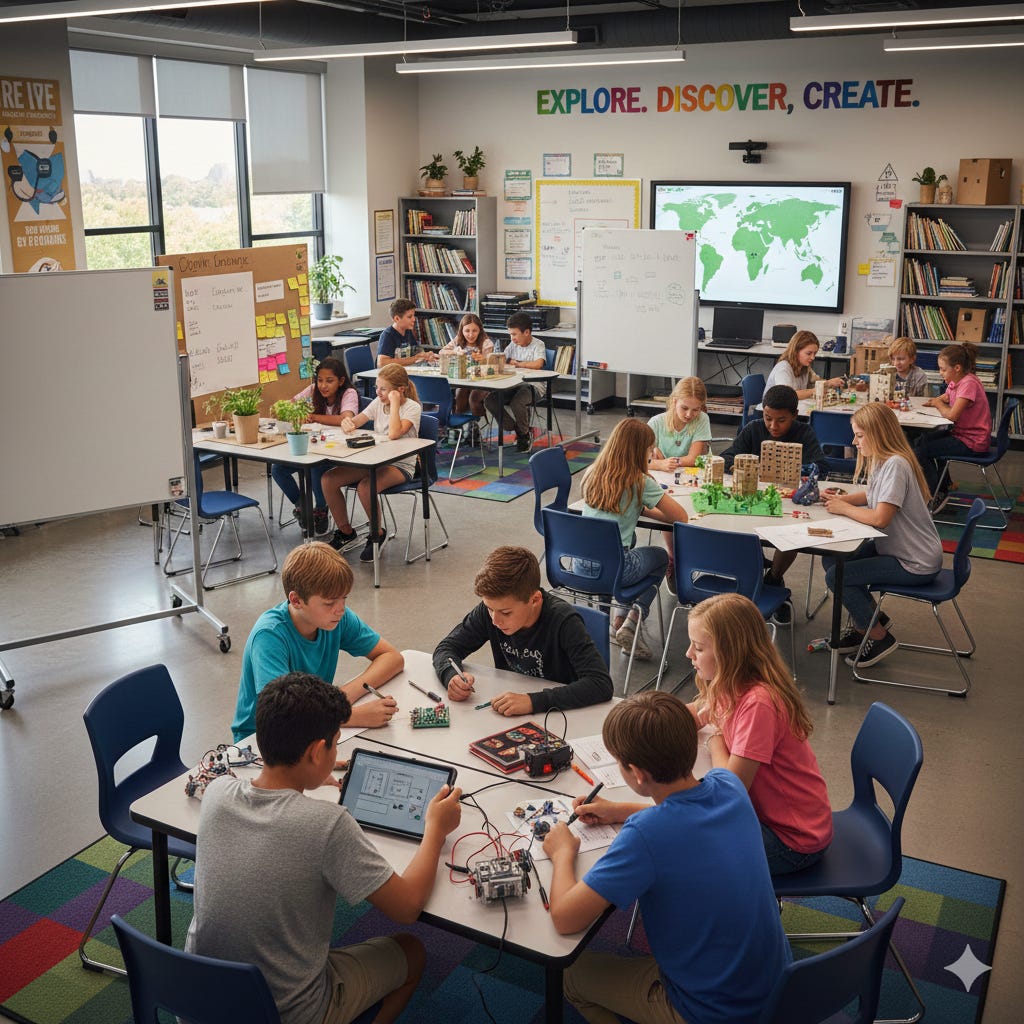
In a PBL context, students are busy. They are moving, talking, building, and searching. Because the students look like highly engaged in doing something, they (and their teachers) assume they are learning.
In reality, students often confuse “doing things” with “learning things.” They feel a sense of accomplishment because they completed a task, but they haven’t necessarily encoded the necessary concept in their memory.
(Misconception: Doing = Learning.)
2. The “Sub-assembly” Gap: Building with Shadows
This is where the illusion becomes risky. For instance, student in a PBL unit on “Sustainable Cities” might talk about “carbon footprints” and “urban planning.” They might feel like they are doing higher-order thinking. It feels “expert-like” and sophisticated.
But again, If they haven’t mastered the stable sub-assemblies (the basic math of percentages or the science of the carbon cycle), they are building concepts with “shadows”. They are using big words without stable meanings.
The moment the project ends and the social emotional support of the group is removed, their knowledge of the whole collapses because it was never anchored to individual mastery of the parts.
3. The “Hiding in the Noise” Problem
So called “natural” or “authentic” environments (like a PBL project) are mostly full of noise - too many variables, distractions, and irrelevant information. But this noise makes the project feel “real” and “exciting.” The student feels they are “navigating the real world.”
However, our brains have a limited Working Memory. In a PBL setting, that memory is usually used up by the noise: deciding on the font for the poster, debating with a teammate, or searching Google.
As a result, there is no “cognitive room” left for the actual goal (the science or math). The students “feel” busy, but the actual learning goal is buried under the noise.
“Novices see only what is there; Experts can see what is not there.”
With experience, a person gains the ability to visualize how a situation developed and to imagine how the situation is going to turn out.
(Seeing the invisible: Perceptual-cognitive aspects of expertise. Klein & Hoffman, 1993)
4. The Expert-Novice Fallacy
PBL assumes that students CAN use an authentic process the way a scientist or a designer use. The assumption is that students learn to think like a researcher by thinking like a researcher. And this is a fallacy that is killing learning because, like Klein and Hoffman (1993) said, students (novices) cannot think like researchers or scientists (experts).
We know that experts can handle “integrated” tasks because their sub-skills are internalized, automatic, and flexible. Scientists don’t have to “think” in the moment about how to use a microscope; they can completely focus on the experiment.
But students do not have that level of automaticity and flexibility. When you ask a school student to “do what a scientist does,” you are overwhelming their working memory. You are asking them to think about how to use the tool, how to work in a group, AND how to solve the problem all at once. Asking this would be like asking someone who hasn’t learned to walk yet to run a marathon.
In other words, you are asking them to think like an expert. Which they are not.
Conclusion: The Quiet Cruelty of the Mirror
The greatest illusion of Project-Based Learning is that it acts as a seductive mirror. It reflects back exactly what we want to see in a modern classroom: students who look like mini-scientists, talk like young entrepreneurs, and produce artifacts that look like the “real world.”
But if we take a closer look, we will realize that this mirror is reflecting a superficial performance, not a permanent change in the student’s cognition.
Students leave the classrooms with a high sense of confidence but a low level of competence. This combination is disastrous when they finally face a problem that cannot be solved with a Google search or a colorful poster or an AI generated idea.
As Herbert Simon tells us, complexity is built from stable parts. If the parts are not stable: if the math is shaky, the reading is slow, and the concepts are shallow, then the project is not a “learning experience”. It is an entertaining exercise in managing confusion.
If we want the students to eventually think like experts, we must first respect the fact that they are novices who lack the implicit knowledge of experts. Give them the sturdy pillars of foundational knowledge so that, one day, they can construct their own houses.
P.S.
I know someone will surely have pushbacks.
Like:
“But PBL builds ‘Soft Skills’ like collaboration and leadership!”
“But students are so much more motivated when they do projects!”
“We need to teach 21st-century skills like Critical Thinking!”
“The teacher should be a ‘Guide on the Side,’ not a ‘Sage on the Stage’.”
“PBL is ‘Real-World’ learning. Traditional teaching is ‘Artificial’.”
I am open to reading/hearing some new ones.
I shared this post on Linkedin here. The comment section is wild and quite interesting.
Greetings,
Thank you for writing this op-ed. As a teacher working at a high school that runs on a Project Based Learning model with inter-disciplinary multi-graded studios, I would like to bring some counter points to some of your claims.
-Education is contextual, blanket claiming something to work, or not, most of the time seems far-fetched. Project Based Learning is a tool. How you integrate it, how much of your curriculum is shaped around it, how much agency does the teacher have in co-creating this course, are all important foundational questions to measure if it works for your context or not? Our school's studio curriculum is created around 6 academic pillars:
-Communication and Expression
-Mathematical Thinking
-Social Systems, Civic Engagement & Ethical Thinking
-Technology and Digital Citizenship
-Scientific Inquiry
-Design and Innovation.
For example for this trimester, the studios being offered to students: Local Agents of Change (inspired from Marshall Ganz's Public Narrative), Politics on your Plate (Ceramics class for food combinations), Matter Matters (Material Science for Climate Change).
- Yes, there is tendency of Project Based Learning to have a higher weigh towards short term excitement. And that is why we try to use student created reflections and documentation as the most important part of any project, in order to bring some balance of long term mastery. In fact, we define mastery for our students as when they are ready to become teachers to other students, and have a dedicated block of time for peer learning groups for students to choose what they want to learn or teach.
-And in no way I am claiming that any of this works perfectly. We run into our challenges daily, as all schools do. And that's what we do as educators, come together and trying to figure out this inter generational information transfer task at a pivotal point in their brain development.
-To your sub-assembly point, there might be truth to that. We may START with building with shadows and be playing with the breadth a bit, which I also feel is the point of high school, to be interested in how the real world interacts. But once a student is hooked, I can be the worst teacher and the student still wants to solve the problem so they will extract the information out of me. And the certain depth required for technical and soft skills, we make sure students have enough required and elective studios to attend from which will allow them to find their interests from the breadth and grow deeper in them.
Scratch is one of the most beautiful learning platforms made to learn programming. Why does it work at that scale? Low barrier to entry, but the ceiling is limitless. A month ago I demonstrated a speech therapy demo to a early childhood school on Scratch, which took me 15 mins to build.
-And again, none of this is being prescribed as 100% works for all. For some students it can be truly life changing, and for some it can be a very tough time. Does that mean you abandon the tool itself? Or understand it as a tool and hope to use it for its merits and avoid its pitfalls.
{Typed on phone. Apologies for typos}
I wonder what is your evidence to back up these claims. I've spent several years doing research on PBL in science classrooms. It is not a perfect method and it needs to be done by skilled teachers, but most actual studies shows that when it is done right, it supports students' cognitive learning just as good as traditional classroom learning, with the added value of social and emotional engagement, and self-efficacy. Several reviews confirm these claims. You easily dismiss the benefits of PBL as a whole, without any concrete evidence from field studies- I find this populistic and dangerous- though I will be happy to be proven wrong...